 | ||||
|
| Tutorial: Performance Management (cont. 2)
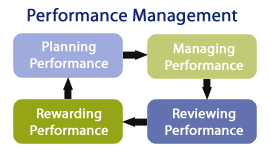
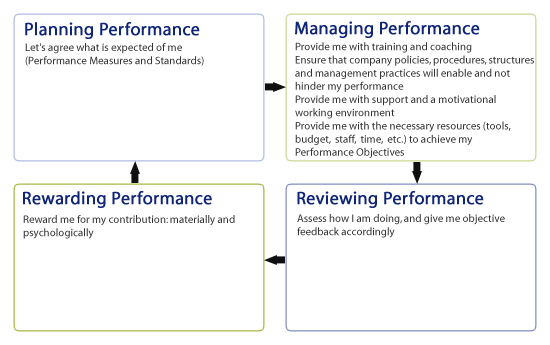
Definition PERFORMANCE MANAGEMENT is a system and process which links the organisation's goals and strategies to individual and team performance so as to increase organisational effectiveness. It is a joint process that involves both the line manager and the employee who identify common goals, which correlate to the higher goals of the organisation. This process results in the establishment of written performance expectations later used as measures for feedback and performance assessment. Performance Management is about providing direction, clarity and support to the work that employees do so as to optimise their effectiveness and efficiency in line with the needs of the organisation. It focuses both on objectives (the 'what') and on style and behaviours (the 'how'), so that it is possible to assess not only whether employees are achieving their individual objectives that have been set, but also whether their performance is in line with the organisation's preferred values and culture, e.g. teamwork, customer focus, interpersonal relationships, participative management style, etc. (doing the RIGHT THINGS in the RIGHT WAY). The model below illustrates the four stages of Performance Management:
This model is aligned with the WORK NEEDS of individual employees, which are as follows:
To provide for the above needs of an employee, let's consider what should happen at each stage of the Performance Management Cycle: 1. Planning Performance: Performance objectives for individual employees (at all levels) are jointly discussed and agreed during one-on-one, face-to-face meetings between jobholders and their immediate line managers - normally for a period of 12 months. (Similarly, objectives could be set for whole work teams, provided that the team members are totally interdependent, working towards achieving the same goal/output, i.e. each team member contributes a portion towards it) 2. Managing Performance: During this stage the jobholder implements/executes the agreed objectives. He manages his own performance, assisted by his line manager who should remove performance obstacles in the work environment and provide the necessary resources, training and coaching. The line manager is also responsible for integrating and co-ordinating (horizontally and vertically) the objectives of all his employees/units/teams, monitoring and controlling their performance, taking corrective action, and doing joint problem solving as and when necessary. The leadership, feedback, reinforcement and support he needs to give them throughout, are of utmost importance. In practice, Planning Performance and Reviewing Performance can take place during one session, called the PERFORMANCE INTERVIEW. Download Appraisal Smart PDF Brochure
| ||||
|
 home l about us l modus operandi l contact us l performance management l staff appraisal course synopses l coaching & counselling l staff recruitment & selection l site map Performance Associates Ltd 1, Botany Town Centre, Auckland 1730, New Zealand Tel: +64 9 555 5555 Fax: +64 9 555 5555 Email: info@performanceassociates.co.nz _____________________________________________ Copyright © 1997 - 2005 Performance Associates Ltd | |||||