|
| | Tutorial: Performance Management (cont. 3)
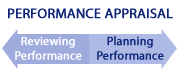
The PERFORMANCE REVIEW INTERVIEW consists of two stages:
(1) REVIEWING PERFORMANCE: A "backwards" look at how well previously set objectives were achieved, and the factors that affected their achievement.
(2) PLANNING PERFORMANCE: A "forwards" look at new objectives to be achieved during the next performance cycle.
In the following sections we will investigate how each of the four stages of Performance Management is handled, starting with the Planning of Performance. It is important to note that Performance Management is not an additional responsibility that managers now get. Rather, it should be seen as an effective WAY of managing. In fact, managing employee performance is the essence of a manager's job, along with business planning, controlling the budget, and managing the production or client service process The MOST IMPORTANT OBJECTIVES of Performance Management are: - To serve as a vehicle for implementing organisational goals and strategies
- To facilitate continuous performance improvement, organisation development and culture change
- To achieve quality and efficiency, i.e. to meet the customer's needs as precisely, quickly and cheaply as possible
- To ensure clarity regarding work expectations and standards, reducing resource wastage and conflict
To continually enhance employee competence through the identification of output-related training and development needs and strategies - To facilitate performance-based remuneration and reward
- To serve as a legal basis in addressing persistent poor performance
BENEFITS OF PERFORMANCE MANAGEMENT A. Benefits to the Organisation - Facilitates the achievement of corporate goals and strategies
- Facilitates the management of change
- Leads to continuous improvement of performance, systems, processes, structures, and management practices
- Leads to improved productivity and work standards
- Provides a basis for enhanced teamwork
- Limits resource wastage
- Ensures optimal utilisation of personnel
- Helps build a climate of openness and trust
- Creates a participative work culture
- Establishes a performance culture - of quality, efficiency and achievement
- Provides useful information for HR decisions (T&D, Manpower & Succession Planning, Career Management)
- Leads to a competent work-force
- Serves as a legal basis to address persistent poor performance
- Provides the basis for fair remuneration based on actual performance
B. Benefits to Employees - Ensures clarity regarding work expectations and standards
- Provides a clear basis/yardstick for discussing performance in a fair way
- Energises and motivates; enhances job satisfaction
- Is a tool for assessing employees' competencies (or lack thereof), leading to targeted training and development; helping them to realise their potential
- Facilitates career development
- Provides a basis for improved relationships with line managers and co-workers
- Facilitates regular feedback on performance
- Provides a forum to share new ideas and to air views
Download Appraisal Smart PDF Brochure 
| |